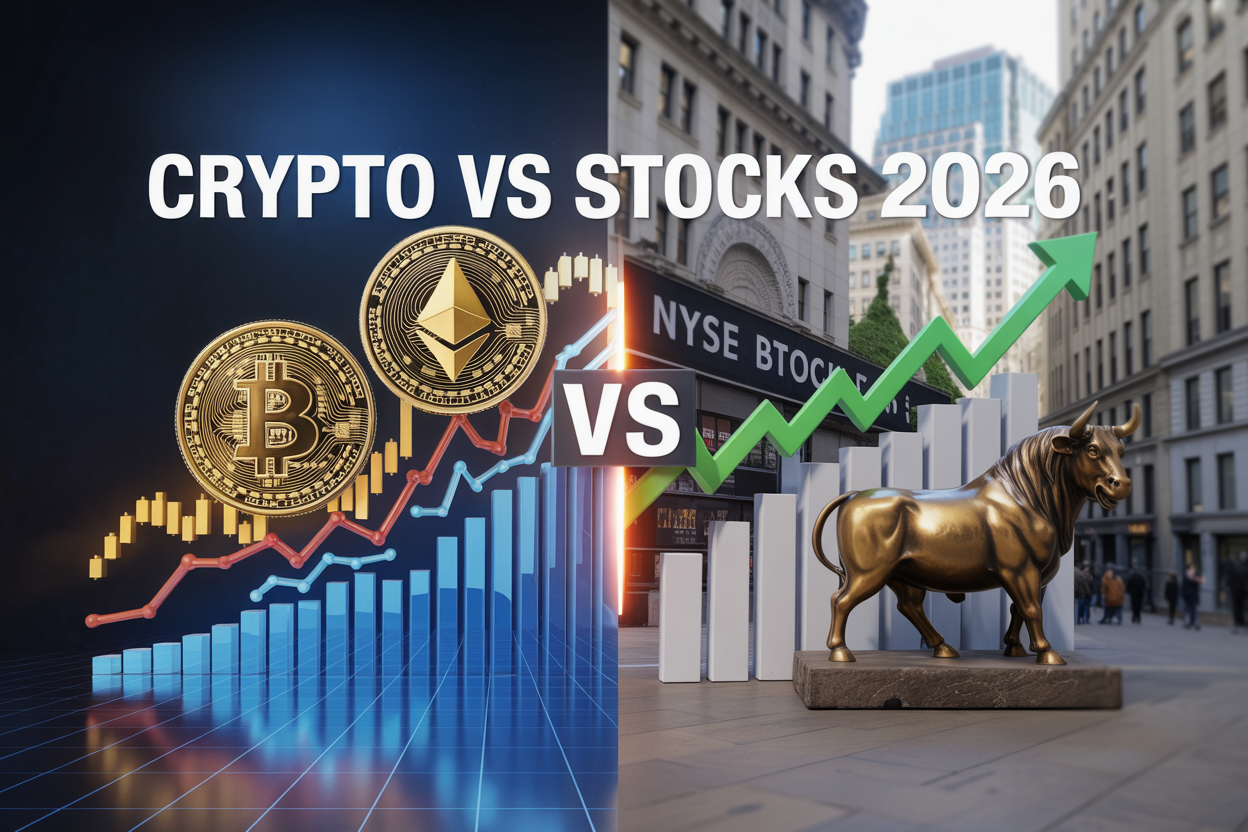

Crypto vs Stock Trading: Which Is More Profitable in 2026?
New traders and seasoned investors are asking the same question: should you put your money in crypto or stocks this year? Both markets offer profit opportunities, but they work very differently and suit different types of people.
This guide is for anyone trying to decide where to invest their hard-earned money. Maybe you’re just starting out with a few hundred dollars, or you’re an experienced trader looking to diversify your portfolio.
We’ll break down the real profit potential each market offers in 2026’s current conditions. You’ll also learn about the major risk differences between crypto and stock trading, plus what it actually takes to get started in each market. By the end, you’ll know which option fits your financial goals, risk tolerance, and available time better.
Understanding Risk and Volatility Differences Between Markets
Crypto’s Extreme Price Swings and 24/7 Market Impact on Profits
Cryptocurrency markets operate like caffeinated traders who never sleep. Bitcoin can drop 20% on a Tuesday afternoon, then surge 15% by Thursday morning. These wild price movements create opportunities for massive gains, but they also bring heart-stopping losses that can wipe out months of profits in hours.
The 24/7 nature of crypto trading means you’re essentially playing a game that never ends. While you’re sleeping, news from Asia can tank your portfolio. A celebrity tweet at 3 AM can send your holdings to the moon or straight into a crater. This constant market activity amplifies both profit potential and risk exposure exponentially.
Day traders love crypto’s volatility because a single well-timed trade can yield 50-100% returns within days. However, this same volatility has destroyed countless portfolios when traders overleveraged or failed to set proper stop-losses. The psychological toll of watching investments fluctuate wildly around the clock cannot be understated.
Stock Market Stability and Predictable Trading Hours Advantage
Traditional stock markets operate on a more civilized schedule. The NYSE opens at 9:30 AM and closes at 4:00 PM Eastern Time, giving you weekends and nights to actually sleep without worrying about your portfolio imploding. This predictability allows for better planning and emotional management.
Stock price movements, while significant, rarely match crypto’s extreme swings. A 5-10% daily move in individual stocks is considered substantial, whereas crypto routinely sees 20-30% fluctuations. Blue-chip stocks like Apple or Microsoft provide steady, more predictable returns that compound over time without causing daily panic attacks.
The stability comes at a cost though. Those moderate price movements mean profit potential is naturally limited compared to crypto’s explosive growth periods. You’re trading potential astronomical gains for peace of mind and more consistent, measurable progress.
How Market Maturity Affects Your Potential Returns
Cryptocurrency markets remain in their adolescence, creating inefficiencies that savvy traders can exploit. Information asymmetries, regulatory uncertainty, and emotional trading create profit opportunities that simply don’t exist in mature stock markets. However, this immaturity also means higher failure rates and unexpected market-wide crashes.
Stock markets benefit from decades of regulation, established financial reporting standards, and institutional oversight. This maturity reduces wild speculation but also eliminates many arbitrage opportunities. The trade-off is clear: mature markets offer more predictable, sustainable returns while emerging crypto markets provide explosive potential with corresponding risks.
Market maturity directly correlates with the types of profits available. Crypto rewards risk-takers and early adopters with life-changing gains, while stocks reward disciplined, long-term investors with steady wealth accumulation. Your profit strategy must align with your chosen market’s maturity level.
Profit Potential Analysis for 2026 Market Conditions

Cryptocurrency growth projections and emerging opportunities
Bitcoin and major altcoins are positioned for significant growth as institutional adoption continues accelerating through 2026. Several key catalysts are driving this momentum: regulatory clarity in major markets, the launch of Bitcoin and Ethereum ETFs, and increasing corporate treasury allocations. Analysts project Bitcoin could reach $150,000-$200,000 by late 2026, representing potential 300-400% gains from current levels.
Emerging opportunities within the crypto ecosystem include:
- Layer 2 scaling solutions for Ethereum, with tokens like Polygon and Arbitrum showing 500-1000% growth potential
- DeFi protocols offering yield farming opportunities with annual returns of 15-30%
- AI and blockchain integration projects expected to capture significant market share
- Real World Asset (RWA) tokenization platforms bridging traditional finance with crypto
- Gaming and NFT ecosystems recovering from previous lows with new utility-focused projects
The total crypto market cap could surge from $2.5 trillion to $8-10 trillion by 2026, driven by retail adoption in emerging markets and institutional investment flows exceeding $500 billion annually.
Traditional stock market expected returns and dividend income
The S&P 500 historically delivers 10-12% annual returns, but 2026 projections suggest more modest 6-8% growth due to economic headwinds and high market valuations. Technology stocks may underperform compared to 2020-2021 as interest rates stabilize and growth premiums compress.
Dividend-focused strategies become increasingly attractive:
| Sector | Expected Dividend Yield | Growth Potential |
|---|---|---|
| Utilities | 3.5-4.5% | Stable |
| REITs | 4-6% | Moderate |
| Consumer Staples | 2.5-3.5% | Conservative |
| Energy | 3-5% | Volatile |
Value investing opportunities emerge in undervalued sectors like healthcare, financials, and industrial companies trading below historical price-to-earnings ratios. International markets, particularly in Asia and Europe, offer diversification benefits with potentially higher returns than U.S. markets.
Impact of global economic factors on both markets
Central bank policies dramatically influence both markets, with Federal Reserve decisions on interest rates creating ripple effects across asset classes. Higher rates typically favor stocks over crypto, as investors seek yield from bonds and dividend-paying stocks. Conversely, rate cuts often trigger crypto rallies as investors chase higher-risk, higher-reward assets.
Inflation trends shape investment strategies differently across markets. Stocks of companies with pricing power outperform during inflationary periods, while crypto often serves as a hedge against currency debasement, though correlation with tech stocks remains high during market stress.
Geopolitical tensions create distinct impacts:
- Stock markets typically see sector rotation toward defense and energy companies
- Crypto markets experience volatility but benefit from safe-haven demand in countries with currency instability
Supply chain disruptions continue affecting manufacturing stocks, while energy transition policies boost renewable energy investments and impact traditional energy sector valuations.
Seasonal trends that affect profitability timing
Crypto markets exhibit unique seasonal patterns that savvy traders exploit. The “crypto winter” typically occurs during Q1-Q2, followed by strong performance in Q4 as institutional investors increase allocations before year-end. Bitcoin’s four-year halving cycle creates predictable bull runs approximately 18 months post-halving events, with the next cycle peak expected in late 2025 or early 2026.
Monthly patterns show crypto strength during the first and last weeks of each month, coinciding with payroll cycles and institutional rebalancing. Weekend trading often creates opportunities due to lower liquidity and institutional absence.
Stock market seasonality follows established patterns:
- January Effect: Small-cap stocks outperform as investors deploy fresh capital
- Sell in May: Summer months historically show weaker performance
- Santa Claus Rally: December often brings gains from holiday optimism and portfolio adjustments
- Earnings Seasons: Quarterly reporting periods create volatility and opportunities
Smart money recognizes these patterns while avoiding over-reliance on seasonal timing. Successful traders combine seasonal awareness with fundamental analysis and risk management to maximize profit potential across both markets.
Capital Requirements and Accessibility Factors

Minimum investment amounts needed to start profitable trading
Getting into crypto trading can cost virtually nothing. Most exchanges let you start with as little as $10 to $25, making it incredibly accessible for beginners. You can buy fractional shares of Bitcoin or Ethereum, meaning you don’t need thousands of dollars to get a piece of the action. Many platforms like Coinbase or Binance have no minimum balance requirements, so you can literally start with your coffee money.
Stock trading used to require much higher entry points, but things have changed dramatically. Robinhood, Webull, and other commission-free brokers now offer fractional shares starting at $1. Traditional brokers like Fidelity and Charles Schwab have followed suit, eliminating most account minimums. However, if you want to day trade stocks seriously, you’ll need at least $25,000 due to Pattern Day Trader rules – a significant barrier that doesn’t exist in crypto.
The real difference comes down to meaningful profit potential. While you can start trading both markets with minimal capital, building substantial wealth typically requires larger initial investments. Crypto’s volatility means smaller amounts can potentially generate bigger returns, but also bigger losses. With stocks, steady growth often requires more capital to see meaningful dollar gains.
Platform fees and transaction costs comparison
| Fee Type | Crypto Exchanges | Stock Brokers |
|---|---|---|
| Trading Fees | 0.1% – 1.0% per trade | $0 – $6.95 per trade |
| Spread Costs | 0.1% – 0.5% | 0.01% – 0.1% |
| Withdrawal Fees | $1 – $25 | Usually free |
| Inactivity Fees | Rare | $0 – $50/quarter |
Crypto exchanges typically charge percentage-based fees ranging from 0.1% to 1% per transaction. Coinbase Pro charges around 0.5% for most trades, while Binance offers rates as low as 0.1% with their native token. These fees can add up quickly for frequent traders, especially when moving smaller amounts.
Stock trading has become remarkably cost-effective. Most major brokers now offer zero-commission stock trades, though you might still pay small regulatory fees (usually under $1). Options trading typically costs $0.50 to $0.65 per contract. The hidden cost in stocks comes from bid-ask spreads, which are generally tighter than crypto but can still impact returns on large trades.
Crypto withdrawal fees deserve special attention. Moving Bitcoin off an exchange might cost $10-25, while Ethereum transfers can be even pricier during network congestion. Stock brokers rarely charge for withdrawals or transfers between accounts.
Regulatory barriers affecting market entry
Stock trading operates under well-established regulatory frameworks that create both barriers and protections. The SEC requires brokers to verify your identity, income, and investment experience. Some complex instruments like options require additional approval levels based on your financial situation and trading knowledge. Day trading rules kick in once you make four or more day trades in five business days with less than $25,000 in your account.
Crypto regulation remains a patchwork of evolving rules. Most exchanges require basic identity verification, but the process is often faster and less invasive than traditional brokers. You won’t face income requirements or suitability tests before buying Bitcoin. However, this regulatory uncertainty creates its own risks – exchanges can face sudden shutdowns or restrictions that don’t affect traditional brokers.
Geographic restrictions hit both markets differently. Some states have stricter requirements for crypto exchanges, while certain countries ban cryptocurrency trading entirely. Stock trading restrictions usually relate to specific securities rather than entire asset classes. International traders often find crypto more accessible since many exchanges operate globally, while stock trading typically requires citizenship or residency in specific countries.
Tax reporting adds another layer of complexity. Crypto transactions trigger taxable events with every trade, requiring detailed record-keeping that many platforms don’t automatically provide. Stock trades are more straightforward, with brokers providing comprehensive tax documents at year-end.
Time Investment and Learning Curve Considerations

Daily time commitment required for successful crypto trading
Successful crypto trading demands significant daily attention due to the market’s 24/7 nature. Unlike traditional markets, crypto never sleeps, creating both opportunities and pressure for traders. Most profitable crypto traders dedicate 4-8 hours daily to market analysis, trade execution, and portfolio monitoring.
The time breakdown typically includes:
- Market analysis: 2-3 hours for chart reading, news monitoring, and sentiment analysis
- Active trading: 1-2 hours for order placement and position management
- Portfolio review: 30-60 minutes for performance assessment and strategy adjustments
- News monitoring: 1-2 hours staying updated on regulatory changes, project developments, and market sentiment
Crypto’s volatility means missing key moments can result in substantial losses. Many traders set multiple alarms throughout the day and night to catch breakouts or manage risk during high-volatility periods. Weekend trading adds another layer of time commitment that stock traders don’t face.
Research intensity needed for stock market analysis
Stock market analysis requires deep, methodical research but operates within more predictable timeframes. Professional stock traders typically invest 3-5 hours daily in research and analysis, focusing on fundamental and technical factors.
Key research areas include:
- Financial statement analysis: Reviewing quarterly earnings, balance sheets, and cash flow statements
- Industry trends: Understanding sector performance, competitive landscapes, and regulatory impacts
- Economic indicators: Monitoring GDP growth, interest rates, inflation data, and employment figures
- Technical analysis: Studying price patterns, volume trends, and momentum indicators
Stock research benefits from established frameworks and decades of historical data. Companies provide regular financial reports, and analyst coverage offers additional insights. The research process is more structured but requires patience, as stock movements often unfold over weeks or months rather than hours.
Technical skills development timeline for each market
The learning curves for crypto and stock trading differ significantly in complexity and timeline.
Crypto Trading Timeline:
- Weeks 1-4: Basic exchange navigation, wallet setup, and understanding major cryptocurrencies
- Months 2-6: Technical analysis fundamentals, DeFi protocols, and risk management strategies
- Months 6-12: Advanced trading strategies, yield farming, and cross-chain operations
- Year 2+: Mastery of complex derivatives, arbitrage opportunities, and institutional-level strategies
Stock Trading Timeline:
- Months 1-3: Market basics, order types, and fundamental analysis principles
- Months 3-9: Technical analysis, sector analysis, and portfolio construction
- Months 9-18: Advanced valuation methods, options strategies, and risk management
- Years 2-5: Professional-level analysis, institutional strategies, and consistent profitability
Crypto’s faster pace means traders can see results quicker but also face steeper learning curves around new technologies. Stock trading rewards patience and methodical skill development over longer periods.
Automation tools available to reduce time investment
Both markets offer automation tools that can significantly reduce hands-on time requirements while maintaining trading effectiveness.
Crypto Automation Tools:
| Tool Type | Examples | Time Savings |
|---|---|---|
| Trading bots | 3Commas, TradeSanta, Cryptohopper | 60-80% |
| Portfolio tracking | CoinTracker, Koinly, Blockfolio | 70-90% |
| DeFi automation | Yearn Finance, Harvest Finance | 80-95% |
| Alert systems | TradingView, Coinigy | 50-70% |
Stock Market Automation:
| Tool Type | Examples | Time Savings |
|---|---|---|
| Robo-advisors | Betterment, Wealthfront | 85-95% |
| Algorithmic trading | QuantConnect, Interactive Brokers | 70-90% |
| Screening tools | Finviz, Stock Rover | 60-80% |
| News aggregation | Bloomberg Terminal, Yahoo Finance | 40-60% |
Crypto automation tools are often more accessible to retail traders and can handle complex DeFi strategies automatically. Stock market automation tends to be more mature and reliable, with institutional-grade tools increasingly available to individual investors. Both markets allow traders to maintain positions and capture opportunities without constant manual oversight, making profitable trading more sustainable for those with limited time availability.
Long-term Wealth Building Strategies

Compound Growth Potential in Traditional Stock Investments
The power of compound growth in stock markets has created generational wealth for countless investors over decades. When you reinvest dividends and allow your gains to accumulate, your money starts working exponentially harder. A $10,000 investment in the S&P 500 index 30 years ago would be worth over $200,000 today, demonstrating the remarkable effect of time and compound returns.
Stock markets benefit from consistent economic growth, corporate earnings expansion, and dividend payouts that create multiple layers of wealth building. Blue-chip companies regularly increase their dividend payments, providing growing income streams that can be reinvested for even greater returns. This creates a snowball effect where your initial investment generates returns, which then generate their own returns.
The beauty of stock investing lies in its proven track record across multiple economic cycles. While individual years may show volatility, the overall trajectory of quality companies and broad market indices has consistently moved upward over extended periods. Dollar-cost averaging into diversified stock portfolios allows investors to smooth out market fluctuations while building substantial wealth over time.
Cryptocurrency Adoption Trends Driving Future Value
Cryptocurrency adoption continues accelerating across institutional, corporate, and retail sectors, creating powerful tailwinds for long-term value appreciation. Major corporations now hold Bitcoin on their balance sheets, while payment processors integrate crypto transactions into everyday commerce. This institutional embrace legitimizes digital assets and drives sustained demand.
The infrastructure supporting cryptocurrency has matured dramatically, with regulated exchanges, custody solutions, and financial products making crypto accessible to mainstream investors. Exchange-traded funds tracking Bitcoin and Ethereum provide traditional investors with familiar investment vehicles while maintaining exposure to crypto’s growth potential.
Emerging economies increasingly adopt cryptocurrencies as alternatives to unstable local currencies, creating global demand that transcends traditional financial boundaries. Smart contract platforms like Ethereum power decentralized finance applications, non-fungible tokens, and Web3 infrastructure, positioning certain cryptocurrencies as foundational technologies for the digital economy.
Regulatory clarity continues improving globally, reducing uncertainty that previously hindered institutional adoption. Central bank digital currencies and government blockchain initiatives further validate the technology’s long-term viability. These trends suggest cryptocurrency’s role in the global financial system will expand rather than diminish.
Portfolio Diversification Benefits Across Both Markets
Smart wealth building combines both traditional stocks and cryptocurrencies to capture different growth drivers while managing risk. These asset classes often move independently, providing natural hedging effects that smooth portfolio volatility over time. When stock markets face headwinds, crypto markets may surge due to different catalysts, and vice versa.
| Asset Class | Correlation with Traditional Markets | Growth Drivers | Risk Characteristics |
|---|---|---|---|
| Traditional Stocks | High correlation with economy | Corporate earnings, GDP growth | Moderate volatility, proven returns |
| Cryptocurrencies | Low correlation with stocks | Technology adoption, monetary policy | High volatility, asymmetric upside |
The optimal allocation depends on your risk tolerance and time horizon, but most financial experts recommend limiting cryptocurrency exposure to 5-15% of total portfolio value. This allocation provides meaningful upside participation without jeopardizing your core wealth building strategy.
Geographic diversification within stock holdings, combined with selective cryptocurrency exposure, creates resilient portfolios capable of generating wealth across different economic environments. International stocks provide exposure to emerging markets and different economic cycles, while crypto offers exposure to technological disruption and monetary innovation.
Regular rebalancing between asset classes ensures you capture gains from outperforming segments while maintaining your target risk profile. This disciplined approach prevents emotional decision-making and creates systematic wealth accumulation regardless of short-term market conditions.

The data shows that both crypto and stock trading offer unique advantages depending on your goals and risk tolerance. Crypto markets present higher profit potential with their volatility, but they also come with significantly greater risk and steeper learning curves. Stock markets provide more stability and proven long-term growth patterns, making them ideal for steady wealth building over time.
Your choice between these markets should align with your financial situation and investment timeline. If you’re comfortable with high-risk, high-reward scenarios and can afford to lose your investment, crypto might offer the explosive returns you’re seeking. For building reliable wealth over the long haul, stocks remain the safer bet with decades of proven performance. Consider starting with stocks to build a solid foundation, then exploring crypto with money you can afford to lose as you gain more experience in the markets.