Stock Trading vs Long-Term Investing: Which Makes More Money?
You want to grow your money, but you’re stuck choosing between active stock trading and long-term investing. This guide is for anyone wondering which approach actually delivers better returns and fits their financial situation.
Both strategies can make money, but they work differently. Day traders and swing traders chase quick profits through buying and selling stocks within days, weeks, or months. Long-term investors buy quality companies and hold them for years, letting compound growth do the heavy lifting.
We’ll break down the real profit potential of stock trading compared to long-term investing strategies. You’ll see actual return comparisons that show what each approach typically delivers. We’ll also cover the risk factors that can make or break your success, so you can pick the money-making strategy that matches your goals and timeline.
Understanding Stock Trading Fundamentals and Profit Potential
Power of compound interest in growing your portfolio
Compound interest transforms modest investments into substantial wealth by earning returns on both your original investment and previously earned returns. When you invest $10,000 and earn 8% annually, you don’t just earn $800 each year. In the second year, you earn 8% on $10,800, then 8% on $11,664 in the third year, and so on.
This snowball effect becomes particularly powerful over extended periods. A $500 monthly investment earning 7% annually grows to approximately $1.37 million over 30 years, while the same amount over 40 years reaches $2.64 million. The extra decade nearly doubles your wealth because compound interest accelerates exponentially.
Einstein allegedly called compound interest the eighth wonder of the world, and the math supports this enthusiasm. Your money works harder as time passes, with each year’s gains contributing to future growth. Starting early maximizes this effect – a 25-year-old investing $200 monthly until retirement will typically accumulate more wealth than a 35-year-old investing $400 monthly for the same duration.
Dollar-cost averaging benefits for consistent wealth building
Dollar-cost averaging involves investing fixed amounts at regular intervals regardless of market conditions. This strategy removes emotion from investment decisions and naturally buys more shares when prices are low and fewer when prices are high.
Consider investing $500 monthly in an index fund. During market downturns, your $500 purchases more shares at lower prices. When markets recover, those additional shares amplify your gains. Over time, this approach typically results in a lower average cost per share compared to attempting to time market entries.
The strategy particularly benefits during volatile markets. While others panic during crashes or get greedy during bubbles, dollar-cost averaging maintains steady investment discipline. Research shows that investors who consistently dollar-cost average often outperform those who try to time the market, primarily because they avoid the costly mistakes of buying high and selling low.
| Market Scenario | Share Price | Shares Purchased | Total Value |
|---|---|---|---|
| Month 1 | $50 | 10 | $500 |
| Month 2 (Crash) | $25 | 20 | $750 |
| Month 3 (Recovery) | $40 | 12.5 | $1,300 |
Tax advantages of holding investments longer than one year
The tax code rewards patience through preferential treatment of long-term capital gains. Investments held over one year qualify for long-term capital gains tax rates, which are significantly lower than ordinary income tax rates applied to short-term gains.
For most investors, long-term capital gains are taxed at 0%, 15%, or 20% depending on income level, while short-term gains face ordinary income tax rates up to 37%. A trader earning $50,000 in short-term gains might pay $18,500 in taxes, while the same gain held long-term could result in just $7,500 in taxes.
Long-term investing also provides tax deferral benefits. You only pay capital gains taxes when you sell, allowing your investments to grow tax-free until you choose to realize gains. This deferral compounds your returns since you’re investing the money that would otherwise go to taxes.
Dividend-focused long-term strategies offer additional tax efficiency. Qualified dividends from stocks held over 60 days receive preferential tax treatment similar to long-term capital gains. These tax savings significantly boost your net returns compared to frequent trading strategies that generate regular taxable events.
Real Money Comparisons Between Trading and Investing Returns
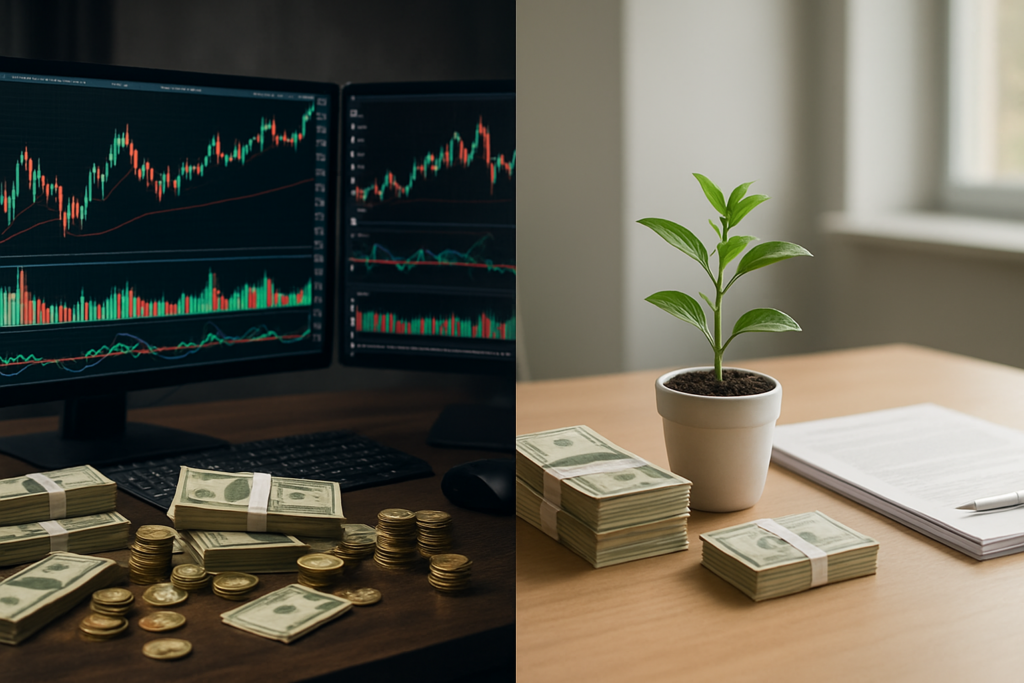
Historical performance data of active traders vs buy-and-hold investors
The numbers tell a stark story when you compare active trading against buy-and-hold investing. Research from DALBAR consistently shows that the average retail investor underperforms the S&P 500 by significant margins. Over the past 20 years, while the S&P 500 averaged around 10% annual returns, the typical equity investor managed only 5.02% annually.
Active day traders face even steeper challenges. Studies tracking thousands of day traders reveal that only 10-15% remain profitable after accounting for all costs. The remaining 85-90% either break even or lose money. Professional trading firms report similar statistics, with most new traders washing out within their first year.
Buy-and-hold investors who simply purchased index funds and held them through market cycles significantly outperformed their active trading counterparts. A $10,000 investment in the S&P 500 in 2000 would be worth approximately $43,000 today, assuming dividend reinvestment. Most active traders starting with the same amount would have substantially less, if anything at all.
The compounding effect becomes particularly pronounced over longer timeframes. Warren Buffett’s famous bet against hedge funds demonstrated this perfectly – his simple S&P 500 index fund choice crushed a collection of professionally managed hedge funds over a 10-year period.
Transaction costs that eat into trading profits
Every trade costs money, and these expenses compound quickly for active traders. While commission-free trading has become common, other costs remain hidden but substantial.
The bid-ask spread represents the most significant hidden cost. When you buy a stock, you pay the ask price, but when you sell, you receive the bid price. This spread typically ranges from $0.01 to $0.10 per share for liquid stocks, but can reach much higher for less liquid securities. A day trader making 50 trades per day faces hundreds of dollars in spread costs weekly.
Platform fees add another layer of expense. Many brokers charge for advanced trading tools, real-time data feeds, and premium research. These monthly subscriptions range from $25 to $200, creating an annual overhead of $300 to $2,400 before making a single trade.
Margin interest compounds the problem for leveraged traders. Borrowing money to amplify positions costs 7-11% annually at most brokers. A trader maintaining $25,000 in margin debt pays $1,750-$2,750 yearly in interest alone.
| Trading Frequency | Annual Transaction Costs* |
|---|---|
| Buy and Hold | $0-50 |
| Swing Trading | $500-2,000 |
| Day Trading | $5,000-15,000+ |
*Based on $100,000 portfolio
Tax implications that reduce net returns for frequent traders
The tax code heavily favors long-term investors over active traders. Securities held longer than one year qualify for preferential capital gains treatment, with rates of 0%, 15%, or 20% depending on income level. Short-term gains from frequent trading are taxed as ordinary income, with rates reaching 37% for high earners.
This tax difference creates a massive drag on trading returns. A trader earning $50,000 annually from short-term gains in the 22% tax bracket keeps only $39,000 after taxes. The same gains from long-term investments would be taxed at 15%, leaving $42,500 – a $3,500 difference.
Wash sale rules add complexity for traders. The IRS disallows losses when you repurchase the same or substantially identical security within 30 days. Active traders frequently trigger wash sales, eliminating their ability to harvest tax losses for offset gains.
State taxes compound the burden in high-tax states like California or New York, where combined federal and state rates can exceed 50% on short-term gains. Long-term investors in these states still benefit from preferential federal rates, significantly reducing their overall tax burden.
Success rates of professional traders versus long-term investors
Professional trading success rates reveal the harsh reality of active strategies. Among proprietary trading firms, roughly 80% of new traders fail within their first year. Even experienced professionals struggle – hedge funds, with their sophisticated strategies and resources, underperform the S&P 500 in most years.
The SPIVA (S&P Indices Versus Active) scorecard consistently shows that 80-90% of actively managed funds underperform their benchmark indices over 10-year periods. These funds employ teams of professional analysts and portfolio managers, yet still fail to beat simple index strategies.
Individual day traders face even worse odds. Academic research tracking brokerage accounts found that less than 1% of day traders consistently profit after costs over multiple years. The vast majority experience the trading equivalent of a slow leak, gradually depleting their capital through small losses and transaction costs.
Long-term investors using broad market index funds achieve market returns minus minimal fees, typically outperforming 80-90% of active strategies over extended periods. This doesn’t require special skills, extensive research, or perfect timing – just patience and discipline to stay invested through market cycles.
The psychological factors also favor long-term investing. Active trading requires constant decision-making under pressure, leading to emotional mistakes that compound losses. Buy-and-hold investing removes most emotional triggers, allowing investors to benefit from market growth without the stress of daily decision-making.
Risk Factors That Impact Your Money-Making Potential
Market volatility effects on short-term trading profits
Short-term traders face constant challenges from market volatility that can make or break their profit potential. When markets swing wildly, traders might think they can capitalize on these movements, but reality often tells a different story. A stock that jumps 5% in the morning can easily drop 8% by afternoon, leaving day traders scrambling to cut losses.
Volatility creates a double-edged sword. While big price swings offer opportunities for quick gains, they also amplify the risk of substantial losses. Professional traders know that even with sophisticated strategies and tools, predicting short-term price movements remains incredibly difficult. Market makers and institutional investors with advanced algorithms often have significant advantages over individual traders during volatile periods.
The speed at which prices change during volatile times can trigger automatic stop-loss orders, forcing traders out of positions at unfavorable prices. This whipsaw effect catches many traders off guard, especially during earnings announcements, economic reports, or geopolitical events that send markets into overdrive.
Emotional decision-making costs in active trading
Trading psychology plays a massive role in determining success or failure. Fear and greed drive most trading decisions, often leading to costly mistakes that eat into profits. When a trade moves against them, many traders panic and sell at the worst possible moment. Conversely, when positions move favorably, overconfidence can lead to holding too long and watching gains evaporate.
The constant pressure of monitoring positions creates stress that clouds judgment. Traders often develop what experts call “revenge trading” – making increasingly risky bets to recover from previous losses. This emotional spiral can destroy accounts faster than any market crash.
FOMO (fear of missing out) pushes traders to chase hot stocks or trends without proper analysis. Social media and trading forums amplify these emotions, creating echo chambers where bad decisions get reinforced. The result is a cycle of buying high and selling low, the opposite of what successful investing requires.
Sleep deprivation from watching global markets affects decision-making quality. Tired traders make more impulsive choices and miss critical warning signs that fresh minds would catch.
Long-term market downturns and recovery patterns
Historical data reveals that markets experience significant downturns roughly every 7-10 years, with smaller corrections happening more frequently. The 2008 financial crisis saw the S&P 500 drop over 50%, while the COVID-19 pandemic triggered a 34% decline in just weeks. These events test every investor’s resolve, but the recovery patterns offer important lessons.
Long-term investors who stay the course typically benefit from market recoveries. The S&P 500 has never failed to reach new highs after major crashes, though recovery times vary. The dot-com crash took about seven years to fully recover, while the 2020 pandemic decline was erased within months thanks to unprecedented monetary policy support.
| Market Downturn | Peak Decline | Recovery Time |
|---|---|---|
| 2008 Financial Crisis | -56.8% | 5.5 years |
| COVID-19 Pandemic | -33.9% | 5 months |
| Dot-com Crash | -49.1% | 7 years |
| 1987 Black Monday | -22.6% | 2 years |
The key difference lies in how each strategy handles these downturns. Traders often get wiped out during crashes because they use leverage and can’t weather the storm. Long-term investors, while seeing paper losses, can hold through the volatility and participate in the eventual recovery. This patience pays off because markets tend to climb higher over extended periods, despite temporary setbacks.
Dollar-cost averaging during downturns can actually boost long-term returns, as investors buy more shares when prices are depressed. This strategy works because downturns are temporary, but the psychological challenge of continuing to invest during scary times separates successful long-term investors from those who panic and lock in losses.
Choosing Your Money-Making Strategy Based on Your Goals

Personal Financial Situation Assessment for Strategy Selection
Your current financial picture plays a huge role in determining whether trading or long-term investing makes sense for you. Start by taking an honest look at your emergency fund. If you don’t have at least three to six months of expenses saved up, focus on building that foundation before diving into either strategy.
Consider your debt situation carefully. High-interest debt like credit cards should typically be your first priority since guaranteed savings on 18-25% interest rates beat most investment returns. Once you’ve tackled expensive debt, evaluate your available capital. Trading requires more liquid cash for frequent transactions and potential losses, while long-term investing can work with smaller, consistent contributions.
Your income stability matters too. People with steady paychecks can handle more investment volatility, while those with irregular income might need more conservative approaches. Factor in upcoming major expenses like home purchases, education costs, or family changes that could impact your investment timeline.
Time Horizon Considerations That Determine Optimal Approach
The timeline for your financial goals dramatically shapes which strategy works best. Short-term goals under five years typically favor more conservative approaches or tactical trading if you have the skills and time. However, trading for short-term needs adds significant risk that could derail important plans.
Long-term investing shines when you have decades ahead of you. The power of compound growth becomes more pronounced over longer periods, and you can ride out market volatility that would crush short-term strategies. Young investors in their 20s and 30s can afford to be more aggressive with growth-focused investments.
Middle-ground timelines of 5-15 years create interesting choices. You might combine both approaches – maintaining a core long-term portfolio while dedicating a smaller portion to trading activities. This hybrid approach lets you scratch the trading itch without jeopardizing your primary wealth-building efforts.
Risk Tolerance Levels That Guide Investment Decisions
Your comfort with risk goes beyond just losing money – it includes how market volatility affects your daily life and decision-making. Some people lose sleep when their portfolio drops 10%, while others see it as a buying opportunity. Understanding your emotional response to losses helps prevent costly panic decisions.
| Risk Profile | Trading Suitability | Investing Approach | Typical Allocation |
|---|---|---|---|
| Conservative | Low to None | Blue-chip stocks, bonds | 60% stocks, 40% bonds |
| Moderate | Limited day trading | Diversified growth | 70% stocks, 30% bonds |
| Aggressive | Active trading possible | Growth stocks, emerging markets | 80-90% stocks |
Risk tolerance also connects to your knowledge and experience. New investors should start conservatively regardless of their theoretical risk appetite. You can always become more aggressive as you learn and gain confidence.
Income Generation Needs Versus Wealth Accumulation Priorities
Different life stages require different approaches to money-making strategies. Retirees or those nearing retirement often need current income, making dividend-paying stocks, bonds, or covered call strategies more attractive than pure growth plays. Trading can provide income, but the irregular nature makes it unreliable for living expenses.
Younger investors focused on wealth accumulation can reinvest all returns and focus on capital appreciation. Growth stocks, index funds, and reinvested dividends compound more effectively than strategies that prioritize current income. Trading profits can accelerate wealth building but require significant skill development.
Consider your tax situation when choosing between income and growth strategies. Trading generates short-term capital gains taxed as ordinary income, while long-term investing benefits from lower capital gains rates. High earners might prefer tax-efficient long-term strategies, while those in lower brackets have more flexibility.
The key lies in matching your strategy to your specific needs rather than chasing the highest potential returns. A solid plan you can stick with consistently beats a perfect plan you abandon during tough times.
Stock trading and long-term investing both offer paths to building wealth, but they work in completely different ways. Trading can deliver quick profits if you’re skilled and lucky, but it demands constant attention, deep market knowledge, and the ability to handle major losses. Long-term investing takes patience but historically rewards those who stick with it, letting compound growth do the heavy lifting while you sleep.
The numbers tell a clear story – while some traders beat the market short-term, most struggle to consistently outperform simple buy-and-hold strategies over decades. Your best choice depends on your personality, available time, and financial goals. If you want to actively manage your money and can handle the stress, trading might work for you. If you prefer a more hands-off approach to building wealth for retirement or major life goals, long-term investing is probably your better bet. Start with whatever strategy matches your current situation, and remember – you can always adjust your approach as you learn and grow.