Starting your journey in trading and investing doesn’t have to mean gambling with your money or taking massive risks to see meaningful returns. This guide is designed for complete beginners who want to grow their wealth smartly – people who have some savings but aren’t sure how to make their money work harder without losing sleep at night.
Many new investors think they have to choose between playing it safe with tiny returns or swinging for the fences with risky bets. The reality is different. You can build a solid investment strategy that protects your capital while still generating attractive returns over time.
We’ll start by breaking down the relationship between risk and return so you understand what you’re really signing up for with different investment choices. Then we’ll walk through building your financial foundation before you put a single dollar into the market – because jumping in without preparation is where most people get burned. Finally, we’ll explore the essential investment vehicles that beginners should know about and show you proven low-risk trading strategies that actually work in real markets.
Understanding Risk and Return Fundamentals

Define low-risk vs high-risk investments
Risk in investing comes down to how much your money might swing up or down over time. Low-risk investments are like that steady friend who always shows up on time – they won’t make you rich overnight, but they won’t disappear either. Think government bonds, high-grade corporate bonds, or certificates of deposit. These investments typically offer returns between 2-6% annually, but you can sleep well knowing your principal is relatively safe.
High-risk investments are the wild cards of the financial world. Stocks of emerging companies, cryptocurrency, options trading, or real estate investment trusts can deliver massive returns – or massive losses. A tech startup stock might double in six months or lose 80% of its value just as quickly. The potential for 15-30% annual returns exists, but so does the chance of losing significant portions of your investment.
The key difference lies in volatility and predictability. Low-risk investments move slowly and steadily, while high-risk investments can experience dramatic price swings based on market sentiment, company performance, or economic conditions.
Calculate realistic return expectations
Setting realistic expectations prevents disappointment and poor decision-making. Historical market data shows that the S&P 500 has averaged around 10% annual returns over the past century, but this includes both boom and bust cycles.
For low-risk investments, expect:
- Government bonds: 2-4% annually
- High-grade corporate bonds: 3-5% annually
- Money market accounts: 1-3% annually
- Conservative balanced funds: 4-7% annually
For moderate-risk investments:
- Diversified index funds: 6-10% annually
- Blue-chip dividend stocks: 5-8% annually
- Real estate investment trusts (REITs): 6-12% annually
Remember that these are long-term averages. Any single year might deliver -20% or +25%. The magic happens when you stay invested through multiple market cycles, allowing compound growth to work in your favor.
Identify the risk-return trade-off myth
The biggest myth in investing is that you must choose between safety and returns – that low risk automatically means low returns forever. This oversimplified view misses several important strategies that can help you achieve better returns while managing risk effectively.
Diversification breaks this myth wide open. By spreading investments across different asset classes, geographic regions, and time periods, you can reduce overall portfolio risk while maintaining growth potential. A portfolio mixing low-risk bonds with moderate-risk index funds often outperforms either asset class alone on a risk-adjusted basis.
Time horizon also changes the equation. What looks risky in the short term becomes less risky over longer periods. Stock market crashes hurt in year one, but over 15-20 years, markets have historically recovered and grown substantially.
Dollar-cost averaging is another myth-buster. By investing fixed amounts regularly regardless of market conditions, you automatically buy more shares when prices are low and fewer when prices are high, smoothing out volatility over time.
Recognize market volatility patterns
Markets move in cycles, and recognizing these patterns helps you make smarter decisions. Bull markets (rising prices) typically last 2-8 years, while bear markets (falling prices) usually last 6-18 months. During bull markets, even conservative investors see steady gains, while bear markets test everyone’s patience.
Seasonal patterns exist too. The “January effect” often sees small-cap stocks performing well early in the year. Summer months tend to be quieter, while fall can bring increased volatility around earnings seasons and economic announcements.
Economic indicators signal potential volatility ahead:
- Interest rate changes affect bond and dividend stock prices
- Employment reports influence consumer spending expectations
- Corporate earnings reports drive individual stock movements
- Geopolitical events create short-term uncertainty
Daily market movements are mostly noise, but weekly and monthly trends reveal genuine shifts in investor sentiment and economic conditions. Smart investors focus on these longer-term patterns rather than getting caught up in daily fluctuations that rarely predict future performance.
Building Your Financial Foundation Before Trading

Establish Emergency Fund Requirements
Before you even think about buying your first stock or cryptocurrency, you need a solid emergency fund sitting in your savings account. This isn’t just financial advice – it’s your insurance policy against life’s unexpected curveballs.
Your emergency fund should cover 3-6 months of essential expenses, including rent, groceries, utilities, insurance, and minimum debt payments. If you’re self-employed or work in an unstable industry, aim for 6-9 months. This money needs to stay liquid and easily accessible, so park it in a high-yield savings account or money market fund.
Why is this so important? Simple – you never want to be forced to sell your investments at a loss because you need cash for an emergency. Market downturns often coincide with economic uncertainty, which is exactly when job losses and other financial emergencies tend to happen.
Calculate your monthly bare-bones budget and multiply by your target number of months. Start building this fund before making any investment moves. Even if it takes 6-12 months to fully fund, this foundation will give you the confidence to weather market volatility without panicking.
Assess Your Risk Tolerance Level
Understanding your risk tolerance goes way deeper than asking yourself “Am I comfortable with risk?” Your risk tolerance is shaped by three key factors: your emotional response to losses, your financial capacity to absorb losses, and your investment timeline.
Start with the emotional component. Can you sleep soundly when your portfolio drops 20% in a month? Some people check their accounts daily and stress over every fluctuation, while others can ignore market noise for months. Be honest about which camp you’re in – there’s no wrong answer, but there’s definitely a wrong strategy for your personality type.
Your financial capacity matters just as much. A 25-year-old with steady income and low expenses can afford to take more risks than someone approaching retirement with limited savings. Consider your job security, income stability, and other financial obligations.
Here’s a simple risk assessment framework:
| Risk Level | Portfolio Allocation | Typical Return Range | Max Expected Loss |
|---|---|---|---|
| Conservative | 20% stocks, 80% bonds | 4-6% annually | 10-15% |
| Moderate | 60% stocks, 40% bonds | 6-8% annually | 20-25% |
| Aggressive | 80% stocks, 20% bonds | 8-10% annually | 30-40% |
Remember, risk tolerance isn’t fixed. It changes with age, income, and life circumstances, so reassess annually.
Set Clear Investment Goals and Timelines
Vague goals lead to mediocre results. “I want to make money” isn’t a strategy – it’s a wish. Your investment goals need to be specific, measurable, and tied to realistic timelines.
Start by categorizing your goals by time horizon:
Short-term (1-3 years): Emergency fund growth, vacation savings, or a down payment fund. These require low-risk, liquid investments like high-yield savings accounts or short-term bonds.
Medium-term (3-10 years): Home purchase, children’s education, or career transition funds. A balanced mix of stocks and bonds works well here, with slightly more conservative allocations as you approach your target date.
Long-term (10+ years): Retirement savings, legacy building, or financial independence goals. You can afford higher risk and more aggressive growth strategies with this timeline.
For each goal, write down:
- Exact dollar amount needed
- Target date
- Monthly contribution required
- Acceptable risk level
- Specific investment vehicles you’ll use
Example: “Save $50,000 for a home down payment by December 2027. Contributing $800 monthly to a balanced portfolio targeting 7% annual returns with moderate risk tolerance.”
This clarity helps you choose appropriate investments and stay disciplined during market turbulence. You’ll know exactly why you’re investing and can measure your progress objectively.
Essential Investment Vehicles for Beginners
Diversified Index Funds and ETFs
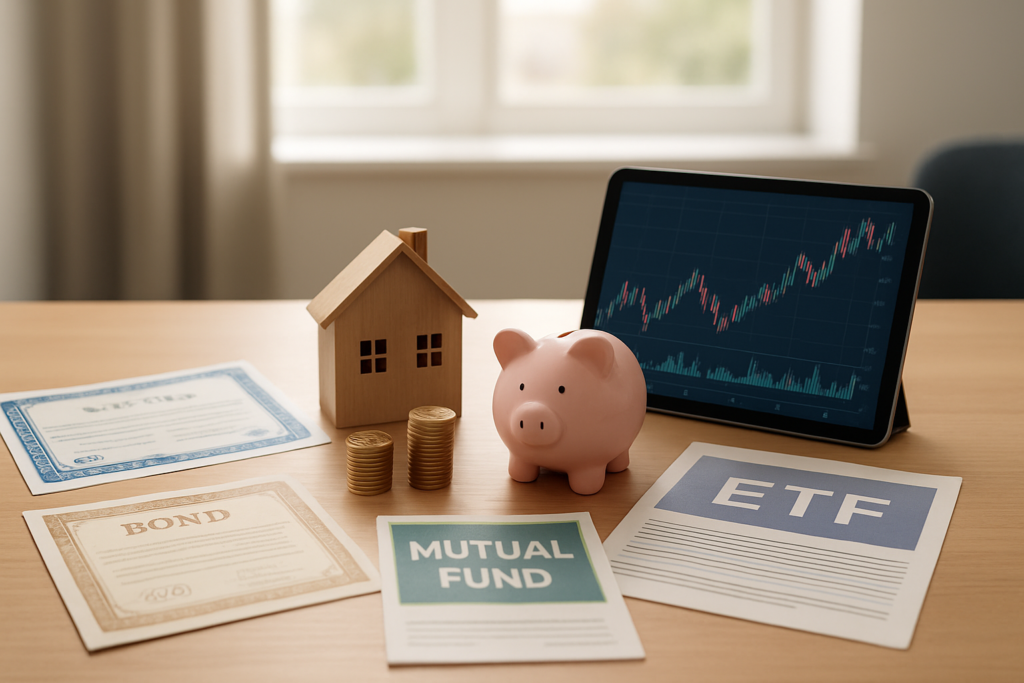
Index funds and exchange-traded funds (ETFs) represent the gold standard for beginner investors seeking broad market exposure without picking individual stocks. These investment vehicles track specific market indexes like the S&P 500, giving you instant ownership in hundreds or thousands of companies with a single purchase.
The beauty of index funds lies in their automatic diversification. When you buy shares of an S&P 500 index fund, you’re essentially buying tiny pieces of Apple, Microsoft, Amazon, and 497 other companies simultaneously. This spreads your risk across multiple sectors and reduces the impact of any single company’s poor performance on your portfolio.
ETFs offer similar benefits but trade like individual stocks throughout the day, while traditional index funds only price once after market close. Both typically charge extremely low fees – often between 0.03% to 0.20% annually – meaning more of your money stays invested instead of going to fund managers.
Popular options for beginners include:
- Total Stock Market Funds: Vanguard VTI or Fidelity FZROX
- S&P 500 Funds: SPDR SPY or Vanguard VOO
- International Funds: Vanguard VTIAX or iShares IEFA
Start with broad market funds before considering sector-specific options. The key advantage here is that you don’t need to research individual companies or time the market – you’re simply betting on the long-term growth of the entire economy.
Blue-Chip Dividend Stocks
Blue-chip stocks represent shares in large, established companies with proven track records of stability and consistent profitability. These corporate giants have weathered multiple economic cycles and continue generating steady cash flows, making them ideal for risk-averse investors seeking regular income.
Dividend-paying blue-chips offer a unique advantage: they pay you to own them. Companies like Coca-Cola, Johnson & Johnson, and Procter & Gamble have increased their dividend payments for decades, creating a growing income stream that often outpaces inflation. This makes them particularly attractive for investors seeking passive income or those nearing retirement.
The stability factor cannot be overstated. While these stocks may not deliver explosive growth like smaller companies, they tend to hold their value better during market downturns. During the 2008 financial crisis, many dividend aristocrats (companies that have increased dividends for 25+ consecutive years) continued paying shareholders even as their stock prices temporarily declined.
Consider these characteristics when selecting dividend stocks:
- Dividend Yield: Look for yields between 2-6%
- Payout Ratio: Ensure dividends represent less than 60% of earnings
- Dividend Growth History: Favor companies with consistent increase patterns
- Financial Health: Strong balance sheets with manageable debt levels
Companies like Microsoft, Apple, and Walmart combine dividend income with potential capital appreciation, offering the best of both worlds for conservative investors.
Government and Corporate Bonds
Bonds function as loans you make to governments or corporations in exchange for regular interest payments and the return of your principal at maturity. They serve as the conservative anchor in most portfolios, providing steady income and helping offset stock market volatility.
Government bonds, particularly U.S. Treasury securities, are considered among the safest investments available. They’re backed by the full faith and credit of the U.S. government, making default virtually impossible. Treasury bonds come in various maturities:
- Treasury Bills: 1 year or less
- Treasury Notes: 2-10 years
- Treasury Bonds: 10-30 years
Corporate bonds offer higher yields but carry additional credit risk. Investment-grade corporate bonds from well-established companies provide a middle ground between safety and return. Companies like Apple, Microsoft, and Disney issue bonds that offer yields typically 1-3% higher than comparable government securities.
Bond investing strategies for beginners:
- Bond Laddering: Buy bonds with staggered maturity dates
- Bond Funds: Instant diversification across multiple issuers
- TIPS: Treasury Inflation-Protected Securities adjust with inflation
Interest rate movements affect bond prices inversely – when rates rise, existing bond values fall. However, if you hold bonds to maturity, you’ll receive your full principal regardless of interim price fluctuations.
Real Estate Investment Trusts (REITs)
REITs allow you to invest in real estate without the hassles of property management, tenant issues, or large capital requirements. These companies own and operate income-producing real estate across various sectors, from shopping malls and office buildings to apartments and data centers.
By law, REITs must distribute at least 90% of their taxable income to shareholders as dividends, making them attractive income-generating investments. This requirement often results in dividend yields between 3-7%, significantly higher than most stocks or bonds.
REITs offer several advantages for beginners:
- Liquidity: Unlike physical real estate, REIT shares trade like stocks
- Professional Management: Experienced teams handle property operations
- Diversification: Exposure to multiple properties and geographic regions
- Lower Barriers: Start investing with just a few hundred dollars
Different REIT categories serve various investment goals:
| REIT Type | Focus | Risk Level | Typical Yield |
|---|---|---|---|
| Residential | Apartments, homes | Moderate | 3-5% |
| Commercial | Office, retail | Moderate-High | 4-7% |
| Healthcare | Hospitals, senior care | Low-Moderate | 4-6% |
| Industrial | Warehouses, distribution | Moderate | 3-5% |
| Data Centers | Server facilities | Moderate-High | 3-6% |
Popular REIT ETFs like Vanguard Real Estate ETF (VNQ) or Schwab U.S. REIT ETF (SCHH) provide instant diversification across the entire real estate sector. Individual REITs like Realty Income Corporation (known as “The Monthly Dividend Company”) offer more targeted exposure to specific real estate strategies.
REITs typically perform differently than stocks and bonds, making them valuable portfolio diversifiers that can reduce overall portfolio volatility while maintaining attractive returns.
Low-Risk Trading Strategies That Work

Dollar-cost averaging implementation
Dollar-cost averaging takes the guesswork out of market timing by investing fixed amounts at regular intervals, regardless of market conditions. This strategy protects you from the emotional rollercoaster of trying to predict market highs and lows.
Start by setting up automatic investments of $100-500 monthly into broad market index funds. When prices drop, your fixed amount buys more shares. When prices rise, you buy fewer shares. Over time, this smooths out your average purchase price and reduces the impact of market volatility.
The beauty lies in its simplicity. Pick a date each month—perhaps the day after your paycheck arrives—and stick to it. Whether the market crashes or soars, you invest the same amount. This removes emotional decision-making and builds discipline.
Consider splitting your monthly investment across different asset classes. Allocate 60% to stock index funds, 30% to bond funds, and 10% to international markets. This diversification spreads risk while maintaining growth potential.
Value investing principles
Value investing focuses on buying quality companies trading below their intrinsic worth. Think of it as shopping for discounts—you want solid businesses at bargain prices.
Look for companies with strong fundamentals: consistent earnings growth, low debt levels, and competitive advantages in their industries. Check the price-to-earnings ratio compared to industry peers. A P/E ratio significantly lower than competitors might signal an undervalued opportunity.
Pay attention to dividend history. Companies that consistently pay and increase dividends over decades demonstrate financial stability and shareholder commitment. These businesses often provide steady income while you wait for stock appreciation.
Read annual reports and understand what the company actually does. Avoid complex businesses you can’t explain simply. Warren Buffett’s rule applies here: if you can’t understand it, don’t invest in it.
Defensive stock selection criteria
Defensive stocks provide stability during economic uncertainty. These companies sell products people need regardless of economic conditions—think utilities, consumer staples, and healthcare.
Focus on companies with recession-resistant business models. Grocery stores, utility companies, and pharmaceutical firms continue generating revenue even when the economy struggles. Their stock prices typically fluctuate less than growth stocks.
Look for businesses with predictable cash flows and established market positions. Companies that have operated successfully for 20+ years and dominate their niches offer more stability than newer, rapidly growing competitors.
Evaluate debt-to-equity ratios carefully. Defensive stocks should carry manageable debt loads—typically less than 50% debt-to-equity. High debt levels can turn defensive stocks risky during economic downturns.
Check dividend sustainability by comparing dividend payments to free cash flow. Sustainable dividends indicate financial health and provide income even when stock prices stagnate.
Asset allocation strategies
Asset allocation determines how you split investments across stocks, bonds, real estate, and cash. Your age and risk tolerance guide these decisions, but starting conservatively makes sense for beginners.
The classic rule suggests subtracting your age from 100 to determine your stock percentage. A 30-year-old might hold 70% stocks and 30% bonds. This balance provides growth potential while limiting downside risk.
| Age Range | Stock % | Bond % | Risk Level |
|---|---|---|---|
| 20-30 | 70-80% | 20-30% | Moderate-High |
| 30-40 | 60-70% | 30-40% | Moderate |
| 40-50 | 50-60% | 40-50% | Moderate-Low |
| 50+ | 40-50% | 50-60% | Conservative |
Rebalance quarterly by selling overperforming assets and buying underperforming ones. This forces you to sell high and buy low systematically. If stocks surge and represent 80% of your portfolio when you target 70%, sell some stocks and buy bonds to restore balance.
Consider adding real estate investment trusts (REITs) for diversification. A 5-10% REIT allocation provides real estate exposure without property management headaches. REITs often move independently of stocks and bonds, adding another layer of risk reduction.
Portfolio Management and Risk Mitigation

Diversification Across Asset Classes
Smart investors spread their money across different types of investments to protect themselves from major losses. When you put all your eggs in one basket, you’re taking a huge gamble. If that one investment tanks, your entire portfolio goes down with it.
The key is mixing different asset classes that don’t all move in the same direction at once. Stocks might be having a rough month while bonds stay steady, or real estate could be booming while commodities struggle. This balance helps smooth out the bumps in your investment journey.
A basic diversification strategy includes:
- Stocks (40-60%): Growth potential but higher volatility
- Bonds (20-30%): Steady income and stability
- Real Estate (10-20%): Inflation hedge and passive income
- Commodities (5-10%): Protection against economic uncertainty
- Cash (5-10%): Emergency fund and opportunity money
Geographic diversification matters too. Don’t just invest in your home country. International markets often perform differently, giving you another layer of protection. Emerging markets might surge while developed countries stagnate, or vice versa.
Regular Rebalancing Techniques
Your portfolio won’t stay balanced on its own. Some investments will grow faster than others, throwing off your original allocation. Rebalancing brings everything back to your target percentages.
Check your portfolio every quarter, but don’t panic if things are slightly off. Small changes happen naturally. Rebalance when any asset class drifts more than 5-10% from your target allocation.
Calendar-based rebalancing works well for most people. Pick specific dates throughout the year – maybe at the end of each quarter or twice a year. This removes emotion from the equation and creates a consistent habit.
Threshold-based rebalancing triggers action when allocations drift too far. If your stock allocation grows from 50% to 60%, you sell some stocks and buy more of your underweight assets.
When rebalancing, consider tax implications. Use new contributions to buy underweight assets before selling anything. In taxable accounts, harvest losses to offset gains and minimize your tax bill.
Stop-Loss Orders and Position Sizing
Stop-loss orders act like safety nets for your investments. They automatically sell a position when it drops to a predetermined price, preventing small losses from becoming disasters.
Set stop-losses at 10-20% below your purchase price for individual stocks. This protects you from major downturns while giving the investment room to fluctuate normally. Adjust your stop-loss upward as the stock price rises to lock in gains.
Position sizing determines how much money you risk on each investment. Never put more than 5-10% of your portfolio into any single stock. Even if you’re confident about a company, unexpected events can crush individual stocks overnight.
Risk-based position sizing calculates your position size based on how much you’re willing to lose. If you’re comfortable losing $500 on a trade and set your stop-loss at 10% below your entry, you can invest $5,000 maximum.
Use trailing stop-losses for winning positions. These automatically adjust upward with rising prices but stay fixed when prices fall. This strategy lets you capture more gains during bull runs while protecting profits when trends reverse.
Tools and Platforms for Smart Investing

Choose the Right Brokerage Account
Selecting the right brokerage account forms the backbone of your investing journey. Look for platforms that offer commission-free trades on stocks and ETFs, as fees can quickly eat into your returns, especially when you’re starting with smaller amounts.
Consider these key factors when comparing brokerages:
- Account minimums: Many top brokers now offer zero minimum accounts
- Trading costs: Focus on platforms with $0 commission for stock and ETF trades
- Investment options: Ensure access to stocks, bonds, ETFs, and mutual funds
- User interface: Choose a platform that matches your experience level
- Customer support: Look for 24/7 support and educational resources
Popular beginner-friendly options include Fidelity, Charles Schwab, and Vanguard for their low costs and educational materials. Robinhood and Webull appeal to mobile-first investors, while TD Ameritrade (now part of Schwab) offers robust research tools.
Use Research and Analysis Tools
Smart investing requires access to quality information and analysis. Most major brokerages provide built-in research tools, but knowing how to use them effectively makes all the difference.
Essential research features to look for:
- Stock screeners: Filter investments based on specific criteria like dividend yield, market cap, or P/E ratio
- Company fundamentals: Access to earnings reports, financial statements, and analyst ratings
- Technical charts: Basic charting tools help identify trends and entry points
- Market news: Real-time news feeds and market analysis
- Educational content: Webinars, articles, and tutorials for continuous learning
Many brokerages partner with research providers like Morningstar or CFRA to offer professional-grade analysis. Take advantage of these resources, but remember that no tool guarantees success – they’re meant to inform your decisions, not make them for you.
Set Up Automated Investment Plans
Automation removes emotion from investing and helps you build wealth consistently. Dollar-cost averaging through automated investments can reduce the impact of market volatility on your portfolio.
Most brokerages offer automatic investment features:
- Recurring purchases: Set up weekly, bi-weekly, or monthly investments
- Dividend reinvestment: Automatically reinvest dividends to compound your returns
- Target-date funds: Professional management that adjusts allocation as you age
- Robo-advisors: Algorithm-based portfolio management with automatic rebalancing
Start with automating investments in broad market index funds or ETFs. Even $50-100 per month can grow significantly over time thanks to compound interest. The key is consistency – automated investing helps you stick to your plan regardless of market conditions.
Monitor Performance With Tracking Apps
Keeping tabs on your investments doesn’t mean checking them every hour, but regular monitoring helps you stay on track with your goals. The right tracking tools provide insights without encouraging harmful over-trading.
Useful monitoring features include:
- Portfolio performance tracking: See how your investments perform over time
- Asset allocation visualization: Ensure your portfolio stays balanced
- Goal tracking: Monitor progress toward specific financial targets
- Alert systems: Get notified of significant price movements or news
Many brokerages include portfolio tracking in their apps, but third-party options like Personal Capital (now Empower) or Mint can aggregate accounts from multiple brokerages. Some investors prefer simple spreadsheets to track their investments without the distraction of constant price updates.
Set a regular schedule for portfolio reviews – monthly or quarterly works well for most long-term investors. This approach keeps you informed without falling into the trap of making emotional decisions based on short-term market movements.
Common Mistakes to Avoid as a New Investor

Emotional Decision-Making Pitfalls
Fear and greed drive more investment losses than any market crash ever could. When you see your portfolio drop 10% in a day, the natural reaction is panic selling. You convince yourself you’re “cutting losses,” but you’re actually locking in those losses while missing the recovery that often follows.
The opposite happens during bull markets. FOMO kicks in hard when you watch your coworker’s crypto portfolio skyrocket or hear about someone’s Tesla gains. You abandon your carefully planned strategy and chase hot stocks at their peaks.
Your brain works against you here. Loss aversion makes you feel losses twice as strongly as equivalent gains. This psychological quirk leads to holding losing positions too long while selling winners too quickly – the exact opposite of what successful investors do.
Set clear rules before you invest and stick to them regardless of emotions. Use limit orders instead of market orders to remove split-second emotional decisions. When you feel the urge to make a dramatic move, sleep on it for 24 hours. Most “urgent” investment decisions aren’t actually urgent at all.
Keep a trading journal noting not just what you bought and sold, but why you made each decision and how you felt. Patterns emerge quickly, and you’ll spot your emotional triggers before they cost you money.
Overtrading and Market Timing Errors
Trading feels productive. Buying and selling gives you the illusion of control and progress. But every trade costs you money through commissions, spreads, and taxes, even when you’re right about direction.
New investors often trade their way to mediocrity. Studies show that retail investors who trade most frequently earn the lowest returns. They mistake activity for achievement and end up worse off than if they’d simply bought index funds and forgotten about them.
Market timing appeals to everyone because it promises the best of both worlds – avoiding losses while capturing gains. The reality is that even professional fund managers with teams of analysts and sophisticated models rarely beat simple buy-and-hold strategies consistently.
Missing just the 10 best days in the market over a 20-year period cuts your returns roughly in half. Since these best days often follow the worst days, you can’t avoid the bad without missing the good.
Focus on time in the market rather than timing the market. Dollar-cost averaging into diversified investments removes the pressure to make perfect entry points. Set up automatic investments so you don’t have to actively decide when to buy.
When you do trade, have specific reasons beyond “the stock looks cheap” or “everyone’s talking about it.” Define your exit strategy before entering any position.
Neglecting Tax Implications
Taxes eat away at investment returns like termites in a house foundation – slowly but devastatingly. Many new investors focus solely on gross returns while ignoring the tax consequences of their trading decisions.
Short-term capital gains get taxed as ordinary income, which can be as high as 37% for high earners. Hold that same investment for just over a year, and you’ll pay long-term capital gains rates of 0%, 15%, or 20% depending on your income level.
This difference is massive. A 10% gain on a short-term trade might net you only 6.3% after taxes, while the same 10% gain held long-term could net you 8.5%. The tax tail shouldn’t wag the investment dog, but it should definitely influence your decisions.
Tax-loss harvesting can offset gains with losses, but wash sale rules prevent you from buying back the same security within 30 days. Many beginners accidentally trigger wash sales and lose the tax benefit they were trying to capture.
Retirement accounts like 401(k)s and IRAs offer tax advantages that compound over decades. Max out these accounts before investing in taxable accounts, especially for long-term goals. Roth accounts are particularly powerful for young investors in lower tax brackets.
Track your cost basis carefully and consider tax implications before selling. Sometimes holding a position longer makes more financial sense even if you think the price might decline slightly.

The path to smart trading and investing isn’t about finding secret shortcuts or chasing get-rich-quick schemes. Success comes from understanding the basics, building a solid financial foundation, and choosing the right mix of investment vehicles that match your comfort level. By starting with low-risk strategies and gradually expanding your knowledge, you’re setting yourself up for sustainable long-term growth rather than gambling with your hard-earned money.
Your investing journey should focus on consistent habits rather than perfect timing. Use the tools and platforms that simplify decision-making, diversify your portfolio to spread risk, and most importantly, learn from the common mistakes that trip up new investors. Start small, stay disciplined, and remember that building wealth is a marathon, not a sprint. Take that first step today by opening an investment account and committing to your financial future.